comparison
Tamiya + Academy

by Meindert de Vreeze

.. ..
.
..
.
COMPARISON 1/32 F-16 kits of Tamiya <> Academy
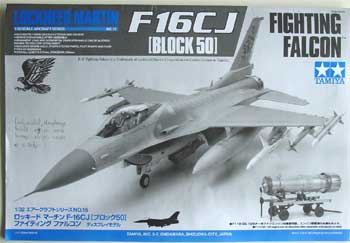
| Tamiya
1/32
F-16CJ Fighting falcon Kit number # 60315 |
Academy
1/32
F-16CG /CJ Fighting Falcon Kit number # 12101 |
| PRICE: | |
| About EURO 135,- in the Netherlands; issued as kit December 2004 | about 80 EURO !! ( 40% lower than Tamiya kit) |
| SUBTYPE: | |
| the
model is a F-16CJ (Block 50 D) and has the big mouth intake for the later
F110 engine. These were used on later F-16 types such as the later made
C's.
tamiya was first with issuing a Big Mouth kit, but Academy also has it now as option in their kit. Other correctly included parts are the thinker wheels and bulged main doors. Other details are the thick base vertical tail. It still is a single seater F-16 however. I discovered that the IFF panel as found on the MLU upgraded Falcons is included as part # 17. |
Several block versions
can be made of this kit: Block 40 or 42 F-16CG or Block 50/52 F-16CJ.
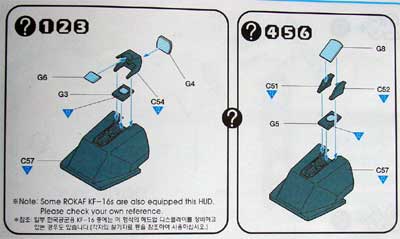
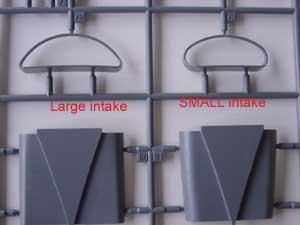
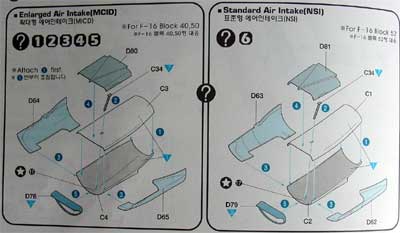
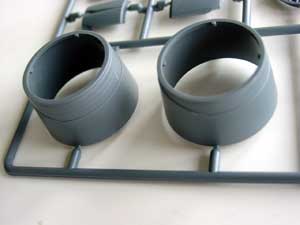
Small or Big Mouth intake!; 2 types of engine fans (F100 and PW 100) and 2 types of exhausts. Several smaller parts can be found in this kit for the different blocks and countries that used the F-16: parachute tail fairing, IFF antennas (as found on MLU upgraded F-16's), 2 types of HUDs . [ Note: you get a "thick" base vertical tail and also one set of main tires and gear so if you want to make earlier F-16's blocks, you will need some cross kitting with some parts from the Hasegawa 1/32 kit #S27 ]. |
| INSTRUCTIONS: | |
Nice
booklet but as usual bit crowded Tamiya style. 65 steps with only Tamiya
Paint color number and paint names.
 |
Fine, with 35 steps.
Comparable to the F-18 style instructions, with FS number but no paint
numbers.
 |
| PARTS: | |
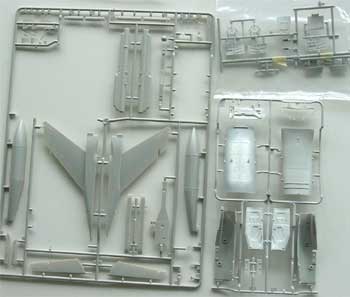
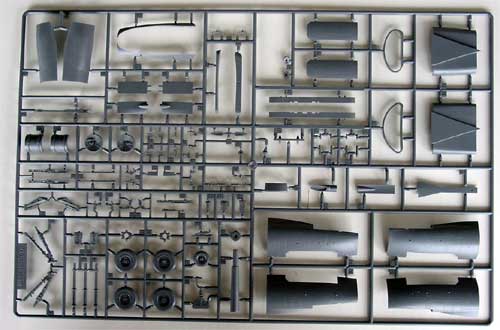
| The
box is really full with about 350 parts, most of them in light grey/white
plastic: 185 parts for the F-16, 25 for the separate F110 engine,
engine dolly 25, 100 for the stores and tanks, 15 parts transparent parts.
All is very nicely packed in separate bags and boxes. Parts have very fine
engraved paneling and some raised details as required.
Also a number of metal parts are supplied for the undercarriage legs and some etched metal for chaff dispensers. Two canopies are supplied, plain glass and gold tinted glass. There is also a painting mask for the canopy, a set of rubber tires (no plastic ones being supplied). The kit is also supplied with small screws and a screwdriver to get some more strength in areas. A small sheet of remove-before-flight tags and a metal insert for the nose weight. A nice colour poster with paint schemes and photos completes this kit. [note:
|
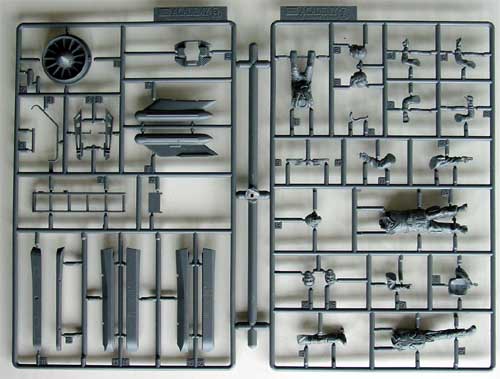
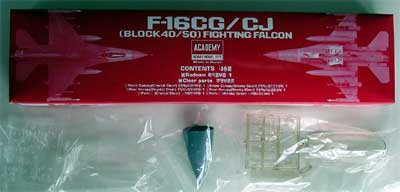
Box
full with about 370 parts in dark grey plastic: 200 for the F-16,
150 for the stores, 20 others. No metal parts are supplied as Academy thinks
this is not needed for the relatively small 1/32 kit. To save costs they
also did not supply you with etched metal or any other gimmicks, but the
plastic parts are just as detailed. And you indeed get two canopies with
plain glass or gold tinted glass. Tyres are of plastic which I think is
better.
All plastic has finely engraved details which is quite comparable to the Tamiya kit. However, strangely enough you will need to remove very subtle flash with a modelling knife in areas and need to polish the surface in areas. But nothing that can not be done with a little effort.
|
| PARTICULARS: | |
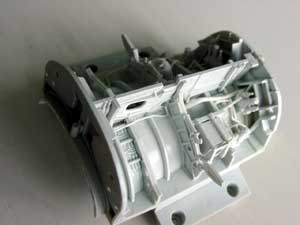
| You
don't only get a F-16 model, you also get a separate F110 engine with an
engine dolly. The engine can be installed and removed from the rear fuselage
for which a detailed bay is provided with this kit.
A good number of external stores are supplied, such as: AMRAAM 120B/C , AIM-9M , a ASQ-213 HARM target pod, AGM-88 HARM missile, ALQ-184 ECM pod, GBU-31J, and two tanks of 300 and one of 370 gallons. For the parts rubber/nylon parts are
supplied that enable you to keep them removable and changeable. The same
is done for the vertical tail and instrument cover. The idea is that you
can remove these parts for transporting the model in its own box after
finishing it. For that purpose you get a carton insert box with the kit.
|
-
you get an excellent F-16 model, not more not less. But 2 pilots and 1
crew member is an extra bonus. And you get much more, read this:
- Stores are superior! Very good quality and includes more than with the Tamiya kit: AIM-9L/M, AIM-9X, AIM-120B/C, AGM-88 HARM, GBU-31 JDAM, GBU-12 Also Paveways and TERs on the GBU-12; 2x 370 gallon tanks and 1x300 centerline fuel tank; ALQ-184 ECM and 2x HTS pod; LANTIRN pod; ALE-50 Fiber-Optic Towed Decoy. ASPJ antenna fairings on the intake. For the ROKAF a specific IFF type antenna panel is supplied. It seems a bit strange on the box picture but is correct. Parts do not seem so complicated as with the Tamiya kit but the end result is just as good.
|
| FIT: | |
| Very good | OK. |
| DETAILS: | |
| Superior!
- Surface detailing very good - Cockpit: fine but small obviously. Raised instrument details, detailed sidewalls. Glass CRT screens and separate instrument cover with HUD. ACES II ejection seat is removable and quite good. Separate belts supplied. Good pilot figure and a ladder is also supplied. Very good cockpit edge locking details. The rear cover behind the seat (in front of the canopy actuator) is I feel is a bit too wide (about 2 mm); - Wing: separate leading edge slat and trailing edge flaps. One single part of upper fuselage and wing, which guarantees correct dihedral and no seams. Later style F-16 RWR receivers on leading edge and metal static dischargers. - Radar nose and radar is also supplied with very fine etched metal antenna. - Canon: also added but no ammo drum. Removable panels. - Air brakes can be set in open position.
|
Very good!
- Engraved paneling is a little less "busy" as compared to the Tamiya kit but the end result is just as good. - Cockpit is fine with no gimmicks such as removable seat rails. Looks fine. ACES II seat is OK but straps are moulded on (Remove these and make separate straps). 2 types of HUDs for the F-16CG/CJ and ROKAF. Ladder supplied with 2 pilot figures. Cockpit edge locking details are missing (add these from some stretched sprue and rod). The sidepanels' recesses should be a bit deeper. The rear cover behind the seat (in front of the canopy actuator) is I feel not wide enough (about 2 mm); - Wing: has only separate trailing edge flaps and 2 wing halves should be aligned and glued to the center wing section. Later style F-16 RWR receivers on leading edge and plastic static dischargers which are separate parts. - Radar nose and radar is also supplied but with plastic parts. Requires some added details. - Canon: also added and including the ammo drum. Removable panels. - Air brakes can be set in open position. |
| DECALS: | |
| TAMIYA
kit has 4 versions; decals are a bit thick but have good coloring and markings.
Only USAF versions: (1) 20 FW, SW Shaw AFB, USAF SerNo 91-0379, Block 50D, Tiger Meet of the Americas 2001 / (2) 77 FS, 20 FW, SW Shaw AFB, USAF SerNo 91-0348, Block 50D / (3) 13 FS, 35 FW, MJ Misawa Japan, USAF SerNo 91-0399, Block 50D / (4) 14 FS, 35 FW, MJ Misawa Japan, USAF SerNo 92-3886, Block 50P ;
|
ACADEMY
KIT has 6 versions: 5 for USAF and 1 ROKAF of Korea;
(1) F-16CG Block 40, 89-2013, 8 FW, Kunsan AB, South Korea, Sep 2004 ; (2) F-16CG Block 40, 89-2003, 35 FS/8 FW Kunsan AB, South Korea, Aug 2004; (3) F-16CG Block 40, 89-2020, 51 FW, Osan AB, South Korea, Sep 2004 ; (4) F-16CJ Block 50, 92-3895, 5 AF (35 FW), Misawa AB, Japan, Feb 2005 ; (5) F-16CJ Block 50, 92-3901, 35 FW, Misawa AB, Japan, Sep 2004 ; (6) KF-16C Block 52, 93-4067, Han-guk Kong Goon, RoKAF ; this has a "F-15" type scheme with Dark Ghost Gray and Light Ghost Gray. Very good set decals for the stores! 
|
| REMARKS: | |
| -
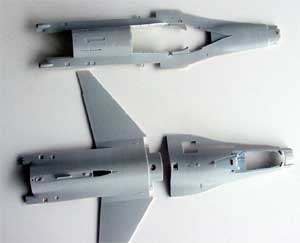
The vertical tail can be kept detachable, when fixed the very small seam
needs minimal filling.
- The engine can be set separate on its nice engine dolly, but you will need another exhaust pipe section which I took from another F-16 kit such as the one of Revell or Hasegawa. (note: the loose engine is a bit thin, otherwise it would not fit into the rear fuselage. But this can hardly be seen I think). - the aft lower rear fuselage cross section shape at the engine bay is not entirely correct; it seems some compromise was needed here as the engine and sub-parts are removable - the engine dolly is a model on its won and needs carefully aligning of the parts. - carefully assemble the big mouth intake, fill the seam. - stores are fine, missile fins are thin enough for me. - wheel bays need some extra piping and details. - some very small ejection pin marks can be found on the inner air brakes. Remove these. - overall fit is excellent!
|
-
this kit builds into a fine F-16. You get a choice here with several blocks
and big or small intakes and the corresponding 2 types of engine exhausts.
With some cross kitting with for example
the (now obsolete) Hasegawa kit, older blocks can be made. Many older block
aircraft have thin wheels and no bulged but straight main gear doors and
these are found in the older F-16 kits on 1/32 scale.
|
| CONCLUSION: | |
| A
very nice state of the art Tamiya model of unseen quality. But this comes
at a high price. I liked the engine and its dolly, but the aft lower fuselage
cross-section is not entirely correct.
Some extras were not really needed such as the nylon parts for removable parts or the transport facility. The kit would than have been cheaper. Recommended if you want to afford
it. NOTE: August 2005 Tamiya issued an older style F-16C Block 32 in the Thunderbirds scheme. It has the smaller intake and a "thick base" vertical tail of the "C". The model does not have the internal engine and engine bay. 
See also tips for converting the Tamiya Thunderbird into a F-16A |
This
Academy kit looks a bit "simpler" than the Tamiya kit but the end result
is just as impressive. You can make more choices and the stores are very
impressive.
This kit is
about 40% cheaper and immediately makes the Hasegawa kits obsolete as these
are not much cheaper.
Issue found
later:
|
| ON TO MODELLING
REPORT OF THE
TAMIYA F-16C KIT.... |
ON TO MODELLING
REPORT OF THE
ACADEMY F-16C KIT.... |
| .
ON TO MODELLING REPORT OF THE ACADEMY conversion to F-16B |
.
ON TO MODELLING REPORT OF THE ACADEMY F-16I SUFA KIT.... |








 "para tail choice"
ALSO CHECK
OUT:
EXTENSIVE
BUILD OF
THE HASEGAWA KITS HERE.......
..
Back
to 1/32 F-16 pages


(c) Copyright "designer"/ All rights reserved. Your comments are welcomed by webmaster
Created this F-16 topic May, 2005